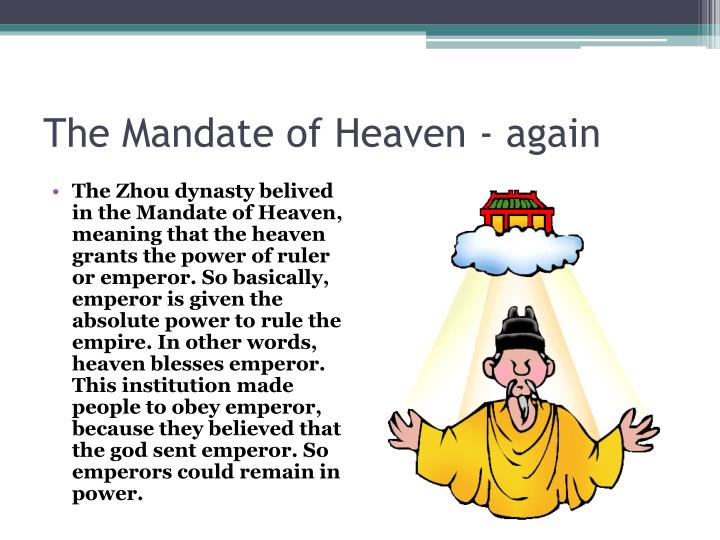
The Mandate of Heaven was often invoked by philosophers and scholars in China as a way to curtail the abuse of power by the ruler, in a system that had few other checks. Chinese historians interpreted a successful revolt as evidence that Heaven had withdrawn its mandate from the ruler. The first Chinese ruler to claim his position and authority came directly from Heaven, which was for the Zhouthe supreme divine force, was King Wen of Zhou, the pre-dynastic feudal state in the Wei river valley of China. Building on a well-established tradition of ancestor worship, this legendary king was known, as his successors would be too, as t...See full list on worldhistory.orgAncient Chinese historians would also later say that only because of the moral credit accrued by Wen's reign was it possible for his successor Wu Wang to finally conquer the Shang dynasty and establish the long-lasting Zhou dynasty. Indeed, the Duke of Zhou described the Mandate of Heaven along with its moral obligation to the conquered Shang peopl...See full list on worldhistory.orgAlthough the early rulers of the Qin state during the Warring States period claimed to have inherited the mantle of Heaven's representatives from the Zhou, later rulers such as China's first emperor Shi Huangdi (r. 221-210 BCE) of the Qin and the HanEmperor Gaozu (r. 202-195 BCE) were much less concerned with the moral aspect of their legitimacy as...See full list on worldhistory.orgFinally, although the emperor remained a hugely influential figure and retained such rights as awarding appointments and giving favours, punishments and pardons, his policies were also circumscribed by those of his predecessors, especially the founder of the dynasty who was viewed as being particularly favoured by Heaven. This was a catch to being ...See full list on worldhistory.orgLearn about the ancient Chinese concept of Mandate of Heaven, which justified the rule of kings and emperors by divine will and moral obligation. Explore the origins, evolution and examples of this idea in Chinese history and culture.See full list on worldhistory.orgMay 4, 2025 · The Mandate of Heaven is an ancient Chinese philosophical concept that determines whether an emperor is virtuous and fit to rule. It justifies rebellion against unjust rulers and explains natural disasters as signs of Heaven's will. Tianming, in Chinese Confucian thought, the notion that heaven (tian) conferred directly upon an emperor, the son of heaven (tianzi), the right to rule. The doctrine had its beginnings in the early Zhou dynasty (c. 1046–256 bce). The Mandate of Heaven is a Chinese philosophical and political concept that asserts that a ruler's authority is granted by divine approval, contingent upon their ability to govern wisely and justly. What was the purpose of the mandate of Heaven?Corollary to the concept of the Mandate of Heaven was the right of rebellion against an unjust ruler. The Mandate of Heaven was often invoked by philosophers and scholars in China as a way to curtail the abuse of power by the ruler, in a system that had few other checks.What are the 4 principles of the mandate of Heaven?There are four principles to the Mandate: No one dynasty has a permanent right to rule. Signs that a particular ruler had lost the Mandate of Heaven included peasant uprisings, invasions by foreign troops, drought, famine, floods, and earthquakes.What was the Emperor's mandate of Heaven?The Mandate of Heaven was the belief that the Chinese emperor had a divine right to rule given him by the god or divine force known as Heaven or Sky. The emperor had absolute power but also a responsibility to rule for the good of his people. Was the Mandate of Heaven the only authority by which an emperor ruled?Why was the mandate of Heaven invoked in China?The Mandate of Heaven was often invoked by philosophers and scholars in China as a way to curtail the abuse of power by the ruler, in a system that had few other checks. Chinese historians interpreted a successful revolt as evidence that Heaven had withdrawn its mandate from the ruler. The Mandate of Heaven is a concept that has shaped Chinese history which stated that rulers who are fair, trustworthy and look after their people, have a sacred right to govern, while those who fail to meet their duties risk losing the mandate and the right to claim the throne. · The Mandate of Heaven was the ancient concept that justified the emperor's rule in China. It depended on the emperor's ability to maintain the cosmic order and the people's welfare, and could be lost or transferred through natural disasters, rebellions, or dynastic changes. · The Mandate of Heaven is an ancient Chinese philosophical concept that determines whether an emperor is virtuous and fit to rule. It justifies rebellion against unjust rulers and explains natural disasters as signs of Heaven's will. Tianming, in Chinese Confucian thought, the notion that heaven (tian) conferred directly upon an emperor, the son of heaven (tianzi), the right to rule. The doctrine had its beginnings in the early Zhou dynasty (c. 1046–256 bce). The Mandate of Heaven is a Chinese philosophical and political concept that asserts that a ruler's authority is granted by divine approval, contingent upon their ability to govern wisely and justly. What was the purpose of the mandate of Heaven?Corollary to the concept of the Mandate of Heaven was the right of rebellion against an unjust ruler. The Mandate of Heaven was often invoked by philosophers and scholars in China as a way to curtail the abuse of power by the ruler, in a system that had few other checks.What are the 4 principles of the mandate of Heaven?There are four principles to the Mandate: No one dynasty has a permanent right to rule. Signs that a particular ruler had lost the Mandate of Heaven included peasant uprisings, invasions by foreign troops, drought, famine, floods, and earthquakes.What was the Emperor's mandate of Heaven?The Mandate of Heaven was the belief that the Chinese emperor had a divine right to rule given him by the god or divine force known as Heaven or Sky. The emperor had absolute power but also a responsibility to rule for the good of his people. Was the Mandate of Heaven the only authority by which an emperor ruled?Why was the mandate of Heaven invoked in China?The Mandate of Heaven was often invoked by philosophers and scholars in China as a way to curtail the abuse of power by the ruler, in a system that had few other checks. Chinese historians interpreted a successful revolt as evidence that Heaven had withdrawn its mandate from the ruler. The Mandate of Heaven is a concept that has shaped Chinese history which stated that rulers who are fair, trustworthy and look after their people, have a sacred right to govern, while those who fail to meet their duties risk losing the mandate and the right to claim the throne. · The Mandate of Heaven was the ancient concept that justified the emperor's rule in China. It depended on the emperor's ability to maintain the cosmic order and the people's welfare, and could be lost or transferred through natural disasters, rebellions, or dynastic changes. Tianming, in Chinese Confucian thought, the notion that heaven (tian) conferred directly upon an emperor, the son of heaven (tianzi), the right to rule. The doctrine had its beginnings in the early Zhou dynasty (c. 1046–256 bce). The Mandate of Heaven is a Chinese philosophical and political concept that asserts that a ruler's authority is granted by divine approval, contingent upon their ability to govern wisely and justly. What was the purpose of the mandate of Heaven?Corollary to the concept of the Mandate of Heaven was the right of rebellion against an unjust ruler. The Mandate of Heaven was often invoked by philosophers and scholars in China as a way to curtail the abuse of power by the ruler, in a system that had few other checks.What are the 4 principles of the mandate of Heaven?There are four principles to the Mandate: No one dynasty has a permanent right to rule. Signs that a particular ruler had lost the Mandate of Heaven included peasant uprisings, invasions by foreign troops, drought, famine, floods, and earthquakes.What was the Emperor's mandate of Heaven?The Mandate of Heaven was the belief that the Chinese emperor had a divine right to rule given him by the god or divine force known as Heaven or Sky. The emperor had absolute power but also a responsibility to rule for the good of his people. Was the Mandate of Heaven the only authority by which an emperor ruled?Why was the mandate of Heaven invoked in China?The Mandate of Heaven was often invoked by philosophers and scholars in China as a way to curtail the abuse of power by the ruler, in a system that had few other checks. Chinese historians interpreted a successful revolt as evidence that Heaven had withdrawn its mandate from the ruler. The Mandate of Heaven is a concept that has shaped Chinese history which stated that rulers who are fair, trustworthy and look after their people, have a sacred right to govern, while those who fail to meet their duties risk losing the mandate and the right to claim the throne. · The Mandate of Heaven was the ancient concept that justified the emperor's rule in China. It depended on the emperor's ability to maintain the cosmic order and the people's welfare, and could be lost or transferred through natural disasters, rebellions, or dynastic changes. The Mandate of Heaven is a Chinese philosophical and political concept that asserts that a ruler's authority is granted by divine approval, contingent upon their ability to govern wisely and justly. The Mandate of Heaven is a concept that has shaped Chinese history which stated that rulers who are fair, trustworthy and look after their people, have a sacred right to govern, while those who fail to meet their duties risk losing the mandate and the right to claim the throne. · The Mandate of Heaven was the ancient concept that justified the emperor's rule in China. It depended on the emperor's ability to maintain the cosmic order and the people's welfare, and could be lost or transferred through natural disasters, rebellions, or dynastic changes. MandateofHeaven love. Define. Relate. List.noun The Chinese philosophical concept of the circumstances under which a ruler is allowed to rule. Good rulers would be allowed to rule with the Mandateofheaven, and despotic, unjust rulers would have the Mandate revoked. The "MandateofHeaven" is a significant concept in Chinese history that originated during the Zhou dynasty (1046-256 BCE). This ideology posits that the right to rule is granted by heaven, the divine force, based on the virtue and moral integrity of the ruler. MandateofHeaven: Gauth AI Solution. 100%(4 rated).According to this belief, heaven bestows the mandate to rule to a just ruler, and if the ruler becomes unjust, heaven would withdraw its support, leading to the downfall of the dynasty. MandateofHeaven. The Chinese philosophical concept of the circumstances under which a ruler is allowed to rule.The MandateofHeaven did not require a ruler to be of noble birth, and had no time limitations. Instead, rulers were expected to be good and just in order to keep the Mandate. Definition 2024. Mandate_of_Heaven.The Chinese philosophical concept of the circumstances under which a ruler is allowed to rule. Good rulers would be allowed to rule with the Mandateofheaven, and despotic, unjust rulers would have the Mandate revoked. A mandate from heaven to grant goodness to those who show goodness. And here’s a look with our Heavens palette #sonofheaven #tianzi #euphoricsun #makeuptutorial #tgcf #heavensmandate Exploring the MandateofHeaven in Chinese History. GHS Flashcards | Quizlet. The MandateofHeaven postulates that heaven would bless the authority of a just ruler, as defined by the Five Confucian Relationships, but would be displeased ... Examples ofheaven in a Sentence. She prayed to God in Heaven. He hopes to go to Heaven when he dies.Middle English heven, from Old English heofon; akin to Old High German himil heaven. First Known Use. before the 12th century, in the meaning defined at sense 1. The so-called "MandateofHeaven" (tianming 天命) was a metaphysical concept to legitimize rule. It was invented by the Zhou dynasty 周 (11th cent.-221 BCE) and shifted the focus away from ancestry to rule by modes of behaviour or performance in leadership, in concrete terms, power... A just ruler had divine approvel, known as the mandateofHeaven. A wicked or foolish King could lose the MandateofHeaven, and therefore lost the right to rule. This system was similar to Divine right in Europe. The MandateofHeaven is defined by the 5 confucian relationships.