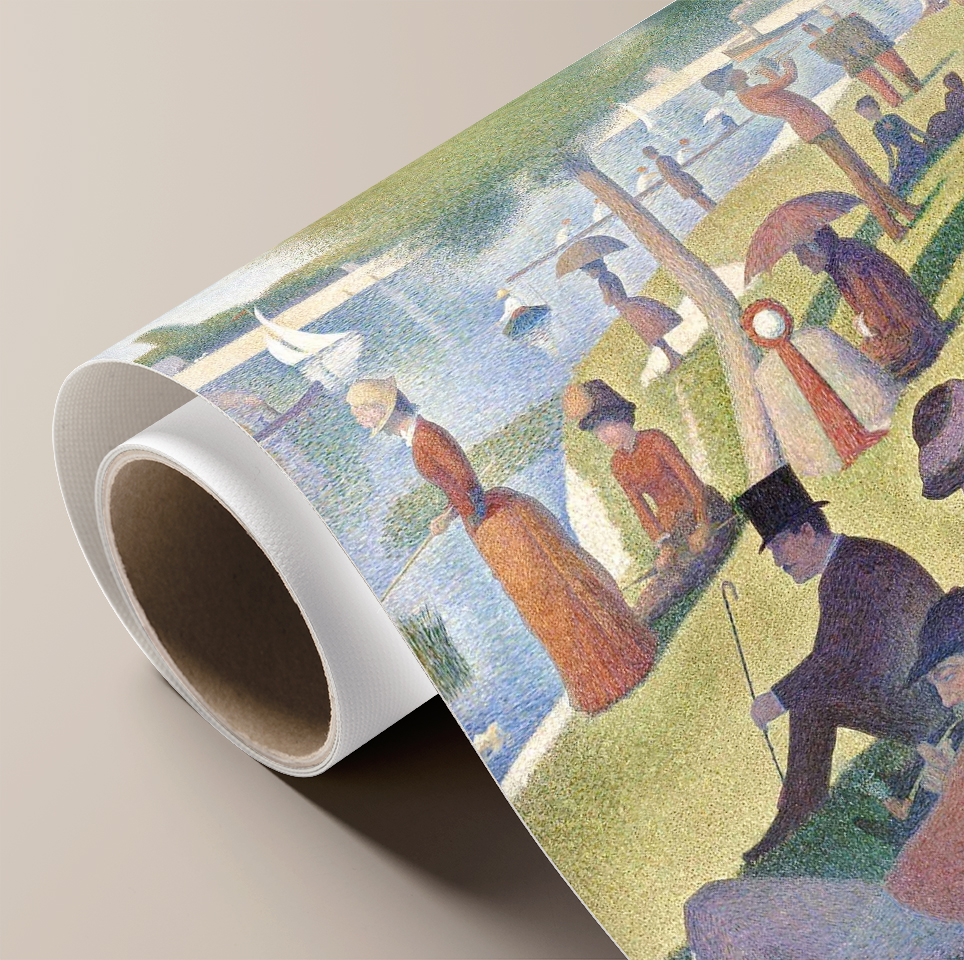
A SundayAfternoon on the Island of La Grande Jatte (French: Un dimanche après-midi à l'Île de la Grande Jatte) was painted from 1884 to 1886 and is Georges Seurat 's most famous work. [1] Seurat is an R package designed for QC, analysis, and exploration of single-cell RNA-seq data. Seurat aims to enable users to identify and interpret sources of heterogeneity from single-cell … Seurat v5 Seurat is an R toolkit for single cell genomics, developed and maintained by the Satija Lab at NYGC. We are excited to release Seurat v5! This updates introduces new functionality … Seurat is an R toolkit for single cell genomics, developed and maintained by the Satija Lab at NYGC. We are excited to release Seurat v5! This updates introduces new functionality for … Seurat: Tools for Single Cell Genomics Description A toolkit for quality control, analysis, and exploration of single cell RNA sequencing data. 'Seurat' aims to enable users to identify and … What is Seurat? Seurat is an R package designed for QC, analysis, and exploration of single-cell RNA-seq data. Seurat aims to enable users to identify and interpret sources of heterogeneity … For new users of Seurat, we suggest starting with a guided walk through of a dataset of 2,700 Peripheral Blood Mononuclear Cells (PBMCs) made publicly available by 10X Genomics. A toolkit for quality control, analysis, and exploration of single cell RNA sequencing data. 'Seurat' aims to enable users to identify and interpret sources of heterogeneity from single cell … Introduction SEURAT is a software tool which provides interactive visualization capability for the integrated analysis of high-dimensional gene expression data. · A toolkit for quality control, analysis, and exploration of single cell RNA sequencing data. 'Seurat' aims to enable users to identify and interpret sources of heterogeneity from single … We are excited to release an initial beta version of Seurat v5! This updates introduces new functionality for spatial, multimodal, and scalable single-cell analysis. In his best-known and largest painting, Georges Seurat depicted people from different social classes strolling and relaxing in a park just west of Paris on La Grande Jatte, an island in the Seine River. A Sunday on La Grande Jatte—1884 is a painting by Georges Seurat completed in 1884–86. It is a masterpiece of pointillism. Georges Pierre Seurat was born in 1859 on 2 December, in Paris. Seurat had two siblings, one brother, and one sister, both were older than him. He was interested in art from a young age and during 1875 he first studied at École Municipale de Sculpture et Dessin, which was the local municipal art school; he studied under Justin Lequien. In 1878 he s...See full list on artincontext.orgAlthough Georges Seurat did not produce many paintings during his short lifetime, he certainly left an impact on the world of art, creating artworks that were not only aesthetically grand but artistically astute. He was remembered as one of the first artists to innovate color theory and to apply it to his paintings, moving away from the Impressioni...See full list on artincontext.orgGeorges Seurat once told the French poet and art critic, Gustave Kahn, “The Panathenaeans of Phidias formed a procession. I want to make modern people, in their essential traits, move about as they do on those friezes, and place them on canvases organized by harmonies of color, by directions of the tones in harmony with the lines, and by the direct...See full list on artincontext.orgSeurat was dubbed as the “Confetti painter” because of the peculiar new style that he introduced into a conservative art world. However, apparently, even some of the Impressionists did not want to exhibit their paintings alongside Seurat’s. Furthermore, because of A Sunday Afternoon on the Island of La Grande Jattesize, approximately 7 by 10 feet, ...See full list on artincontext.orgWho Created the Lazy Sunday Afternoon Painting?The Neo-Impressionist painter, Georges Seurat, created the oil painting titled A Sunday Afternoon on the Island of La Grande Jattein 1884. It depicts various Parisians from the city relaxing at leisure on a green embankment by the River Seine.What Was Georges Seurat’s Painting Technique?Georges Seurat was identified as a Neo-Impressionist, he innovated the new technique called Pointillism, or Divisionism, which he referred to as Chromoluminarism. This consisted of applying “dots” that were individual brushstrokes next to the other that enabled the viewers’ eyes to naturally blend colors instead of blending colors while painting.How Are Impressionism and Post-Impressionism Different?Impressionism was characterized as being more expressive and spontaneous in its style, depicting moments as they appeared, as well as natural lighting. They painted en plein air, which means “outdoors”. Neo-Impressionism was regarded as more precise and “conscious” in rendering a composition, and some art critics thought it was more scientific in its approach in terms of how colors were applied.See full list on artincontext.orgFeb 25, 2025 · Discover the meaning of Georges Seurat’s A Sunday Afternoon on the Island of La Grande Jatte. Explore the hidden details, symbolism, and pointillist technique behind this iconic masterpiece, simply explained. · This most famous and influential Neo-Impressionist work depicts a cross-section of Paris society enjoying a Sundayafternoon in the park on an island in the Seine River just at the gates of Paris. Did Seurat paint a Sunday afternoon on La Grande Jatte?Seurat leaves it open to interpretation. Seurat painted A Sunday Afternoon on the Island of La Grande Jatte in various stages. According to the studies of the Conservation Microscopist, Inge Fiedler, from the Art Institute of Chicago, Seurat painted La Grande Jatte in three stages.What is a Sunday afternoon on the island of La Grande Jatte?A Sunday Afternoon on the Island of La Grande Jatte (French: Un dimanche après-midi à l'Île de la Grande Jatte) was painted from 1884 to 1886 and is Georges Seurat 's most famous work. A leading example of pointillist technique, executed on a large canvas, it is a founding work of the neo-impressionist movement.Who bought Sunday afternoon on the island of La Grande Jatte?Sunday Afternoon on the Island of La Grande Jatte was purchased on the advice of the Art Institute of Chicago's curatorial staff in 1924.When did Seurat paint a Sunday afternoon?Seurat painted A Sunday Afternoon between May 1884 and March 1885, and from October 1885 to May 1886, focusing meticulously on the landscape of the park. He reworked the original and completed numerous preliminary drawings and oil sketches. He sat in the park, creating numerous sketches of the various figures in order to perfect their form. · There is a famous painting that is the quintessence of summertime leisure in a city: A Sunday Afternoon on the Island of La Grande Jatte by the French Post-Impressionist painter and draftsman Georges Seurat. Here’s everything you have to know about this iconic canvas. · Discover the meaning of Georges Seurat’s A Sunday Afternoon on the Island of La Grande Jatte. Explore the hidden details, symbolism, and pointillist technique behind this iconic masterpiece, simply explained. · This most famous and influential Neo-Impressionist work depicts a cross-section of Paris society enjoying a Sundayafternoon in the park on an island in the Seine River just at the gates of Paris. · There is a famous painting that is the quintessence of summertime leisure in a city: A Sunday Afternoon on the Island of La Grande Jatte by the French Post-Impressionist painter and draftsman Georges Seurat. Here’s everything you have to know about this iconic canvas.