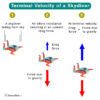
Terminal velocity is the maximum speed an object can reach when falling through a fluid, such as air or water. Learn how terminal velocity depends on factors like mass, area, density, and drag coefficient, and see examples of terminal velocity for different objects and animals. Velocity is a vector quantity, meaning that both magnitude and direction are needed to define it (velocity vector). The scalar absolute value (magnitude) of velocity is called speed, a quantity that is measured in metres per second (m/s or m⋅s−1) in the SI (metric) system. · In this position, the terminal velocity for an average human is approximately 120 miles per hour (193 kilometers per hour). This speed is typically reached after about 12 seconds of freefall. Terminalvelocity is defined as the maximum velocity an object can achieve when falling through a fluid, such as air or water. That happens when the gravitational force working on the object in downward direction equals the sum of upward forces (drag and buoyancy) impeding it's fall. An object moving at terminalvelocity has zero acceleration and c...See full list on gigacalculator.comThe formula for the terminal velocity of a falling object (Vt) can be calculated from the body's mass m, the density of the fluid in question (p, in kg/m3, e.g. 1.225 for air), the cross-sectional area projected by the object (A), and the gravitational (or equivalent) force g in m/s2according to the following equation: This equation applies only fo...See full list on gigacalculator.comExample 1: A cannon ballwith a radius of 30 cm and 20 kg weight is dropped from a plane cruising at high altitude. What is the terminal velocity such a cannon ball can achieve? Let us assume the cannon ball is nearly a perfect sphere. We know that the coefficient of drag for a sphere is about 0.5. Taking the air density to be 1.225 kg/m3 and the gr...See full list on gigacalculator.comHow do you get terminal velocity?Terminal velocity can be achieved by an object provided it has enough distance to fall through so if you want to experience it, you need to jump from a high enough place (do not forget your parachute!). For example, a human body generally needs to fall about 450 meters (1,500 feet) of height before it reaches terminal velocity.How long does it take to reach terminal velocity?Ans. It takes about 12 seconds to achieve terminal velocity. What is the terminal velocity of a human skydiver. How fast can a human skydive. How long does it take to reach this terminal velocity.What is terminal velocity?Terminal velocity is defined as the maximum velocity an object can achieve when falling through a fluid, such as air or water. That happens when the gravitational force working on the object in downward direction equals the sum of upward forces (drag and buoyancy) impeding it's fall.What is the terminal velocity of a human?The terminal velocity of a human in a belly-to-earth position (like a skydiver) is approximately 120 miles per hour (about 193 kilometers per hour). This speed is reached when the force of gravity pulling the person down is balanced by the air resistance pushing up, resulting in no further acceleration. Terminal velocity is the maximum speed an object can reach when falling through a fluid, such as air or water. Learn how terminal velocity depends on factors like mass, area, density, and drag coefficient, and see examples of terminal velocity for different objects and animals. · Learn how the terminal velocity of a human depends on mass, orientation, and air density. Find out how to increase the speed of free fall and how long it takes to reach it. There's a limit to how fast a human can fall, a speed dictated by the fascinating physics of air resistance and gravity: terminal velocity. This article dives into the science behind this natural speed limit, exploring its calculation, real-world implications, and the factors that influence it. If a person changes their position, like diving headfirst, the terminal velocity can increase to around 150-180 miles per hour (about 240-290 kilometers per hour) because of reduced air resistance. · Learn how gravity, mass, shape, and air density influence the speed and trajectory of a falling object. Discover the concept of terminal velocity and how it applies to skydiving, wingsuit flying, and other free fall activities. · Learn how the terminal velocity of a human depends on mass, orientation, and air density. Find out how to increase the speed of free fall and how long it takes to reach it. There's a limit to how fast a human can fall, a speed dictated by the fascinating physics of air resistance and gravity: terminal velocity. This article dives into the science behind this natural speed limit, exploring its calculation, real-world implications, and the factors that influence it. If a person changes their position, like diving headfirst, the terminal velocity can increase to around 150-180 miles per hour (about 240-290 kilometers per hour) because of reduced air resistance. · Learn how gravity, mass, shape, and air density influence the speed and trajectory of a falling object. Discover the concept of terminal velocity and how it applies to skydiving, wingsuit flying, and other free fall activities. The terminalvelocityofa falling body occurs during free fall when a falling body experiences zero acceleration.It is estimated that the human body will reach 99% of terminalvelocity after falling 1,880 feet (573 meters) which takes anywhere from 10-14 seconds. TerminalVelocity, Human. What happens to ahuman at terminalvelocity has everything to do with that human’s orientation in the sky and their presented surface area to the wind. By changing body positions, skydivers can alter their terminalvelocity. Why can’t ahuman survive terminalvelocity if they just tuck and rollnewtonian gravity - What is the terminalvelocityofa sheepTerminalVelocityofHuman Skydiver If an average sized human weighing 70kg was at terminalvelocity what would their de Broglie wavelength be? -27 B) In the largest particle accelerator, the Large Hadron Collider (LHC), protons (1.67262 x 10 kg) move at near light speed. Well does any know the terminalvelocityofahuman, I cant really remember my science and te equations of motion. Surely when he is plumiting to the ground, he will reach a terminalvelocity and acceleration is 0 due to fricitonal force and he isnt getting, although what will the time be... The terminalvelocityofan 80.0-kg skydiver in a pike position is about 115 m/s, which equals approximately 414 km/h. This value is derived from the balance of the drag force and the weight of the skydiver due to gravity. The calculations account for fluid density and the drag coefficient. The highest sustained speed ahuman can reach without mechanical assistance comes from gravity in freefall, where the limit is determined by air resistance. A skydiver falling in a stable, spread-eagle position typically reaches a terminalvelocityof about 195 kilometers per hour (121 mph). Christina Olson is the author of the full-length collections The Anxiety Workbook, TerminalHumanVelocity, and Before I Came Home Naked as well as the chapbooks Weird Science and Rook & The M.E. Her chapbook The Last Mastodon won the 2019 Rattle Chapbook Prize. Pushing the Boundaries of HumanVelocity. Humanity’s fascination with speed is deeply ingrained in our history. From early attempts to break the sound barrier to the ambitious endeavors of space travel, we’ve constantly strived to push the limits of what’s possible. Discover the concept of terminalvelocity and how it relates to human movement with engaging performances and insights. what is terminalvelocity, understanding terminalvelocity, humanvelocity performance analysis, effects of terminalvelocity on speed... Terminalvelocity is the maximum speed of free fall ofahuman in air.The speed ofa diver from a 30 metre cliff is estimated to be only about 90 km per hour. This is only one-third or so of the terminalvelocity. Another factor too is plunging position. The average terminalvelocityofahuman at 100% time is about 186,000 mph. How fast does ahuman's velocity decrease with temperature? In very high falls, bodies can reach terminalvelocity, the speed at which air resistance becomes so high it cancels out the acceleration due to gravity. Once at terminalvelocity, you can fall as far as you like and you won't gather any more speed.