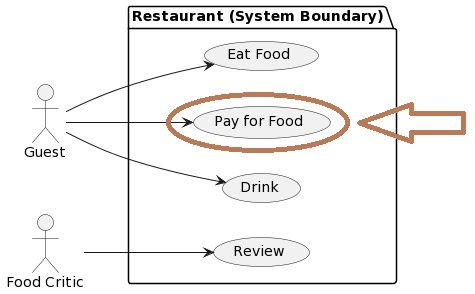
A use case is a list of actions or event steps typically defining the interactions between a role (known in the Unified Modeling Language (UML) as an actor) and a system to achieve a goal. The actor can be a human or another external system. To map out the ways users interact with a system, tool, or product, you need a use case. Use cases are descriptions of the ways users interact with systems to accomplish tasks or reach goals. Mapping these interactions can improve early planning and ensure a smooth development cycle. · Discover what a usecase is and what its characteristics are. Explore usecase benefits, examples and the difference between usecases and user stories. A use case is a description of the ways in which a user interacts with a system or product. It may establish the success scenarios, the failure scenarios, and any critical variations or exceptions. A use case can be written or made visual with the help of a use case model tool.See full list on wrike.comSwedish computer scientist Ivar Jacobson presented the first article on use cases in 1987, describing how the technique was used at telecommunications company Ericsson to capture system requirements. In 1992, Jacobson co-authored the book “Object-Oriented Software Engineering — A Use Case Driven Approach,” which helped popularize use cases for spec...See full list on wrike.comHow do use cases help teams get things done? Here are the most common use cases to help you build successful systems.See full list on wrike.comProject managers need to know about use cases because they help communicate strategy to stakeholders and bridge the gap between business justification and technical requirements. PMI also notes that“use cases provide a structure for gathering customer requirements and setting the project scope.” But what does that mean in practical terms? Let’s say...See full list on wrike.comWhen presented in written form, a use case can be a helpful piece of project documentation. Use cases are a common requirements artifact, and they can smoothen communication across technical and business stakeholders. Depending on the intended audience and system under discussion, the use case can be as detailed or basic as needed. A use case docum...See full list on wrike.comA use case model is a visual representation of the interactions between an actor and a system. As PMI also notes, use case models depict processes, which helps to further express preconditions and triggers. A use case model is commonly expressed using UML. In these visualizations, there are three main components: the system, the actors, and the use...See full list on wrike.comA use case diagram is simply a type of use case model. A use case model diagram uses text and shapes to represent the relationship between a user and a system. Primarily, use case model diagrams are used to: 1. Visualize the flow and behavior of the system 2. Illustrate the functionality of the system 3. Represent key system user interactions Depen...See full list on wrike.comSkip the effort of creating a use case from the group up. Building use cases with Wrike can streamline your product development process and help ensure your software meets the needs of its users. With Wrike’s requirements management template, you can track all of your use case requirements in one place. When it’s time to plan and execute your proje...See full list on wrike.comA use case is a description of how a user interacts with a system or product to achieve specific goals or tasks. Learn the difference between use cases and user stories, the types of use cases, and how to write them effectively with Wrike's template.See full list on wrike.comDec 16, 2025 · The goal of writing a use case is to outline how future users will use your product to meet their goals or needs, or solve their problems. A use case helps you identify target audiences for product development strategy and marketing. · Use cases are critical tools in software development and systems engineering, serving as a methodology to define and analyze how users interact with a system to achieve specific goals. How do you use a case expression?You can use the CASE expression in a clause or statement that allows a valid expression. For example, you can use the CASE expression in statements such as SELECT, DELETE, and UPDATE or in clauses such as SELECT, ORDER BY, and HAVING. The following illustrates the simple CASE expression: result_1 result_2 result_3 ... else_resultWhy do I need a case expression?Being able to use a properly-formatted CASE expression is a good ability to nurture. It allows you to get the results you expect from your queries. If you are interested in learning more about the CASE expression, check out LearnSQL's Standard SQL Functions course. It will show you how to build queries that use this expression and many others.How do you use the case when statement?Solution explanation: This example effectively uses the CASE WHEN statement to categorize products by price range. The conditions are clear and the resulting labels are meaningful, allowing for easier analysis. Exercise: In an online store, ensuring orders are delivered on time is key to customer satisfaction. · In this guide, we’ll define what ausecaseis, describe the elements therein and what they are designed to do, and walk through how to build a usecase step by step. We’ll also look at some usecase examples to show what they look like in practice. · The goal of writing a use case is to outline how future users will use your product to meet their goals or needs, or solve their problems. A use case helps you identify target audiences for product development strategy and marketing. · Use cases are critical tools in software development and systems engineering, serving as a methodology to define and analyze how users interact with a system to achieve specific goals. · In this guide, we’ll define what ausecaseis, describe the elements therein and what they are designed to do, and walk through how to build a usecase step by step. We’ll also look at some usecase examples to show what they look like in practice.